Why would a five-acre horse property in Wayne, Illinois sit under one set of acreage rules, while a nearly identical parcel a few blocks away, still inside the same village limits, sits under a completely different one? The answer has nothing to do with the seller's disclosures or a listing agent's math. It comes down to a boundary older than most of the subdivisions in Wayne: the line where DuPage County ends and Kane County begins, which runs directly through the village rather than around it.
For buyers comparing Fox Valley communities by median price and photos of white board fencing, Wayne can look like one market: big lots, equestrian branding, a single zip code. It isn't one market. Wayne is legally split down the middle, and that split changes the math on horse-keeping, stable construction, school assignment, and how much engineering your septic system needs before it ever goes in the ground.
One Village, Two Counties, Two Sets of Rules
The eastern half of Wayne sits in DuPage County, inside Wayne Township. The western half sits in Kane County, inside St. Charles Township. That isn't a historical footnote. It is active law today. DuPage County requires a minimum of two acres to keep a horse on a residential lot. Kane County requires at least four acres on any property outside a platted subdivision. A parcel that qualifies as horse property on one side of that line does not automatically qualify on the other side, even if the lot sizes look similar on a plat map.
The four-acre standard on the Kane County side did not arrive with modern zoning. It was written into private deeds first. On November 17, 1937, years before Kane County had formal zoning of its own, the Dunham and Norris families and their neighbors on the west side of Dunham Road signed a mutual agreement restricting their land to single-family homes on a minimum of four acres each. Kane County's zoning code later formalized what those landowners had already agreed to decades earlier.
Where the Boundaries Actually Fall
The county line isn't even the only invisible boundary running through Wayne. School assignment follows a separate map entirely. St. Charles Community Unit School District 303 serves the village's south and west portions. Elgin Area School District U-46, the second-largest school district in Illinois, serves the central, north, and east portions. That boundary does not track the county line. A buyer can cross from DuPage into Kane County without changing school districts, then cross a school boundary a few blocks later without the county changing at all.
| DuPage County portion (Wayne Township) | Kane County portion (St. Charles Township) | |
|---|---|---|
| Horse-keeping minimum | 2 acres | 4 acres outside a platted subdivision |
| Origin of the rule | County zoning code | County zoning code, rooted in a 1937 landowner agreement |
A parcel's county determines its horse-acreage minimum. Its position relative to a separate, non-aligned school boundary determines where the kids ride the bus. Neither line shows up on a standard listing sheet.
The Stable Size Formula Hidden in the Village Code
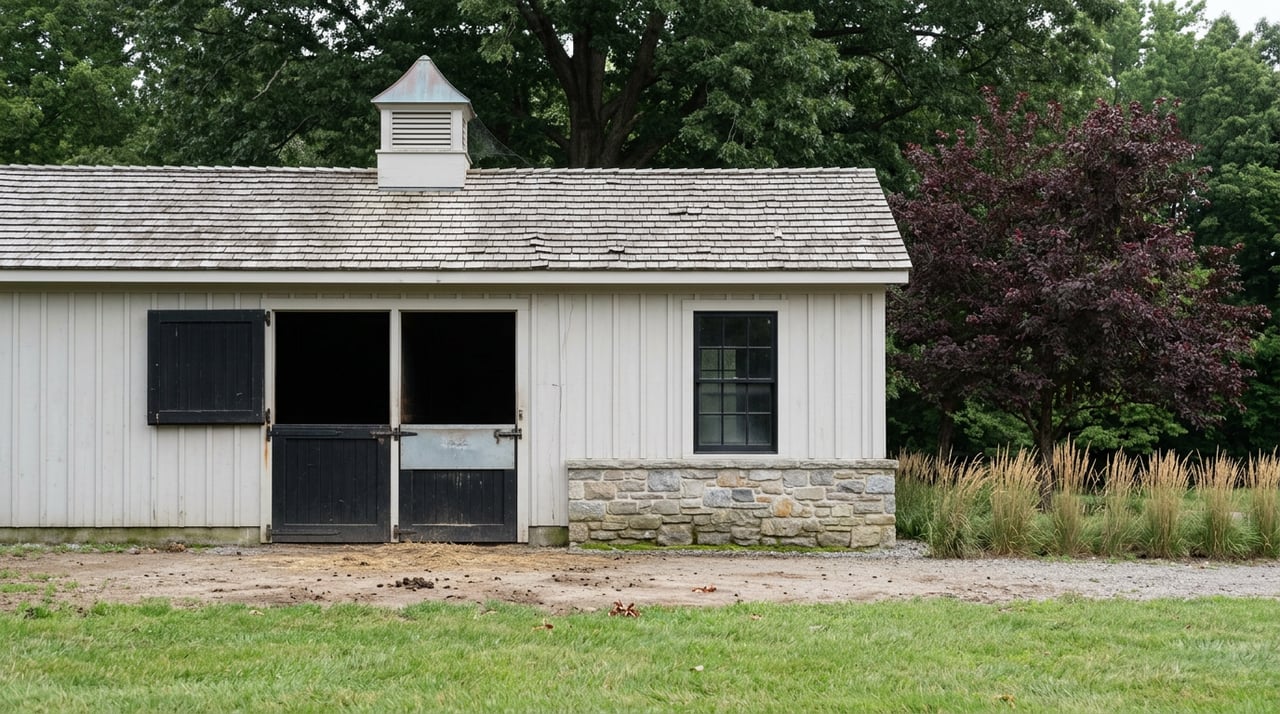
Wayne's own zoning ordinance, which applies village-wide regardless of which county a lot falls in, sets a sliding scale for private stables based on acreage rather than a flat square footage cap. On a lot of at least two acres but less than three, a private stable's first floor is capped at 1,500 square feet. At three acres, that cap rises to 1,700 square feet. At four acres, it's 1,900 square feet. Each additional acre after that adds up to 225 more square feet, but only up to a ceiling of 2,800 square feet. Cross that ceiling and the stable becomes a special use requiring a minimum of 10 contiguous acres under single ownership before the village will even consider approving it.
Commercial stables run on a different scale entirely. Any commercial stable, corral, or equestrian facility needs a minimum of 20 acres. If horses are kept outside, the code allows one horse per acre. If they're kept entirely inside a building, capacity is set by stall count, with each stall required to measure at least 12 by 12 feet and a hard cap of 45 stalls or 100 horses per parcel, whichever limit is reached first.
Wayne also reserves the back 10 feet of nearly every residential lot as a riding easement, a village-wide feature connecting individual properties to the wider network of trails and forest preserve land. A buyer evaluating a lot's usable footprint needs to account for that easement before assuming the full parcel is buildable or fenceable.
Same Village, Two Different Septic Conversations
Most of Wayne runs on private septic systems rather than municipal sewer, according to the village's own planning documents. That alone means septic literacy matters more here than in a typical suburban transaction. The same planning documents flag an added wrinkle specific to the western section, inside Kane County: soils there test with slow permeability, and in some spots the water table sits within 20 feet of the surface. That combination typically means more engineering, testing, and design work before a septic permit is approved, not just a routine inspection before closing.
Illinois Extension's general guidance for septic buyers recommends starting with the local health department to pull permit history, including the system's age, tank size, and lateral field location, well before writing an offer. In a village where soil conditions vary block to block, that step matters more in Wayne than it would somewhere with uniform ground.
What the Sales Numbers Are Actually Telling You
As of May 2026, Wayne homes carried a median list price of $1.04 million. Looking backward at closed transactions, sales completed over the trailing 12 months tracked into this summer carried a median of $925,000, up 29 percent from the prior 12-month period. That increase came from only 19 closed sales. In a market that thin, a jump of that size says more about which specific houses happened to trade than about a structural repricing of the whole village. A similar percentage swing in a Fox Valley town with deeper annual sales volume would represent dozens of transactions and a much steadier signal.
Homes in Wayne also moved quickly, averaging around 18 days on market, well under national norms. In a market with only a handful of sales a year, though, a fast average can be driven by one or two well-priced, well-prepared listings just as easily as by broad demand. Neither number should be read the way a median in a higher-volume suburb would be read.
What This Means If You're Comparing Wayne to Other Fox Valley Towns
Acreage, stable rights, school assignment, and septic complexity in Wayne are not determined by price tier. They are determined by which side of two different, non-aligned boundaries a specific parcel sits on. Two properties listed at the same price, in the same village, with the same acreage on paper, can carry different horse-keeping rights, different stable-size ceilings, different school buses, and different septic engineering requirements. Before writing an offer here, it is worth confirming the county, the school district, and the zoning district for that exact parcel rather than assuming the whole village follows one rulebook.
Do I need four acres to keep a horse anywhere in Wayne? Only on the Kane County side, and only outside a platted subdivision. On the DuPage County side, two acres meets the local minimum, and lots inside an established subdivision may follow that subdivision's own recorded covenants rather than the county baseline.
Why would two Wayne properties with identical acreage have different septic costs? Soil conditions drive septic engineering costs more than lot size does. The village's planning documents note slower-draining soils and a shallower water table in the western, Kane County section, which can mean added design and testing steps compared with a similarly sized lot to the east.
Comparing towns across the Fox Valley on price alone leaves out exactly the kind of detail that changes what a parcel can actually be used for. If you're weighing Wayne against St. Charles, Geneva, or another Fox Valley community and want the county line, school boundary, and zoning district checked before you fall for a listing photo, Tamara O'Connor and her team can walk the specific parcel with you and pull what a standard search won't show. Reach out for a free home valuation and a straight answer on what a given address actually allows.